
Choosing the right drivetrain for navigating the vast and variable landscapes of Wyoming is one of the most critical decisions a vehicle buyer can make. The choice between AWD or 4x4 for Wyoming often dictates how confidently you can travel through changing weather conditions, varying elevations, and mixed road surfaces. Both systems are engineered to distribute power to all four wheels, but they do so using completely different mechanical approaches designed for distinct driving environments. Understanding these differences ensures you select a vehicle that aligns perfectly with your daily routine and recreational pursuits.
For residents navigating the unique terrain around Thermopolis, where rolling hills and rugged valley roads meet geothermal geological features, the choice between these two systems is highly practical. If your typical driving route consists of paved highways, main thoroughfares, and municipal streets that are regularly plowed during the colder months, an AWD system offers continuous, automated stability. It operates seamlessly in the background, constantly adjusting to slick spots without requiring any driver input.
Conversely, if your lifestyle involves leaving the pavement to explore backcountry trails, manage agricultural properties, or navigate deep, unplowed drifts before the county maintenance crews arrive, a dedicated 4x4 system is the industry standard. This setup provides maximum torque multiplication and locked axle speeds, which are essential for crawling out of deep mud or heavy snow. Our team at Fremont Toyota Lander is always ready to help you compare these systems in person. If you want to discuss your specific driving routes or arrange a visit, you can reach us by making a quick call to our showroom, or you can find the best route to our dealership by checking our physical location details online.
Table of Contents
- How Modern All-Wheel Drive Mechanically Differs from Traditional Four-Wheel Drive
- Evaluating AWD versus 4x4 for Wyoming Winter Commuting and Highway Safety
- Fuel Economy and Operational Cost Differences Between AWD and 4x4 Systems
- Towing Campers and Handling Mountain Passes Like South Pass
- Common Questions About AWD and 4x4 Performance in Wyoming
- Finding Your Perfect Winter-Ready Vehicle in Lander
How Modern All-Wheel Drive Mechanically Differs from Traditional Four-Wheel Drive
How does a modern AWD system mechanically differ from a traditional 4x4 system? The core distinction lies in how the front and rear axles communicate and how power is split. A standard AWD system utilizes a center differential, viscous coupling, or an electronically controlled multi-plate clutch pack to distribute torque between the front and rear axles automatically. Because the center differential allows the front and rear driveshafts to rotate at different speeds, AWD can remain permanently engaged on dry pavement. This design prevents driveline binding when you negotiate tight turns, making it a highly sophisticated "set it and forget it" technology.
A traditional 4x4 system, by contrast, relies on a mechanical transfer case to lock the front and rear driveshafts together. When engaged in 4H (4WD High) or 4L (4WD Low), both axles are forced to turn at the exact same speed. While this is highly effective for maximum traction on loose surfaces, driving a locked 4x4 system on dry, high-grip pavement prevents the wheels from turning at different speeds during a corner, resulting in severe driveline binding, tire scrubbing, and potential mechanical damage. For this reason, traditional part-time 4x4 systems must be manually shifted back into two-wheel drive once you return to dry asphalt.
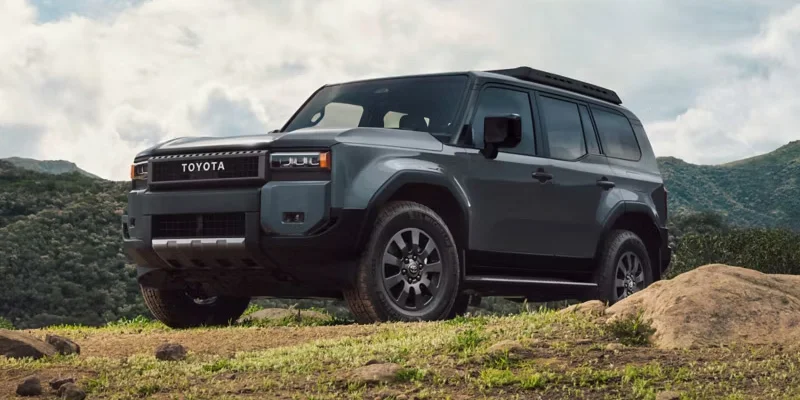
For a concrete comparison of how these mechanical configurations are integrated into modern vehicle lineups, consider the 2026 Toyota 4Runner. This robust SUV is available with a part-time 4x4 system featuring a two-speed transfer case, making it an exceptional option for demanding off-road conditions. Depending on the model configuration, you can experience a variety of powertrain setups. For example, the SR5, TRD Off-Road, and TRD Sport trims feature a 2.4L engine producing 278 hp and 317 lb-ft of torque, paired with an 8-speed automatic transmission.
Meanwhile, high-tier configurations like the TRD Off-Road Premium, TRD Sport Premium, and Trailhunter step up performance with a hybrid variant of the 2.4L engine that delivers 326 hp and 465 lb-ft of torque. To find the mechanical setup that best fits your driving habits, you can browse our new-vehicle inventory online, or take the next step by choosing to schedule a test drive in a new car or schedule a test drive in a used car to feel how these different systems behave on the road.
Evaluating AWD versus 4x4 for Wyoming Winter Commuting and Highway Safety
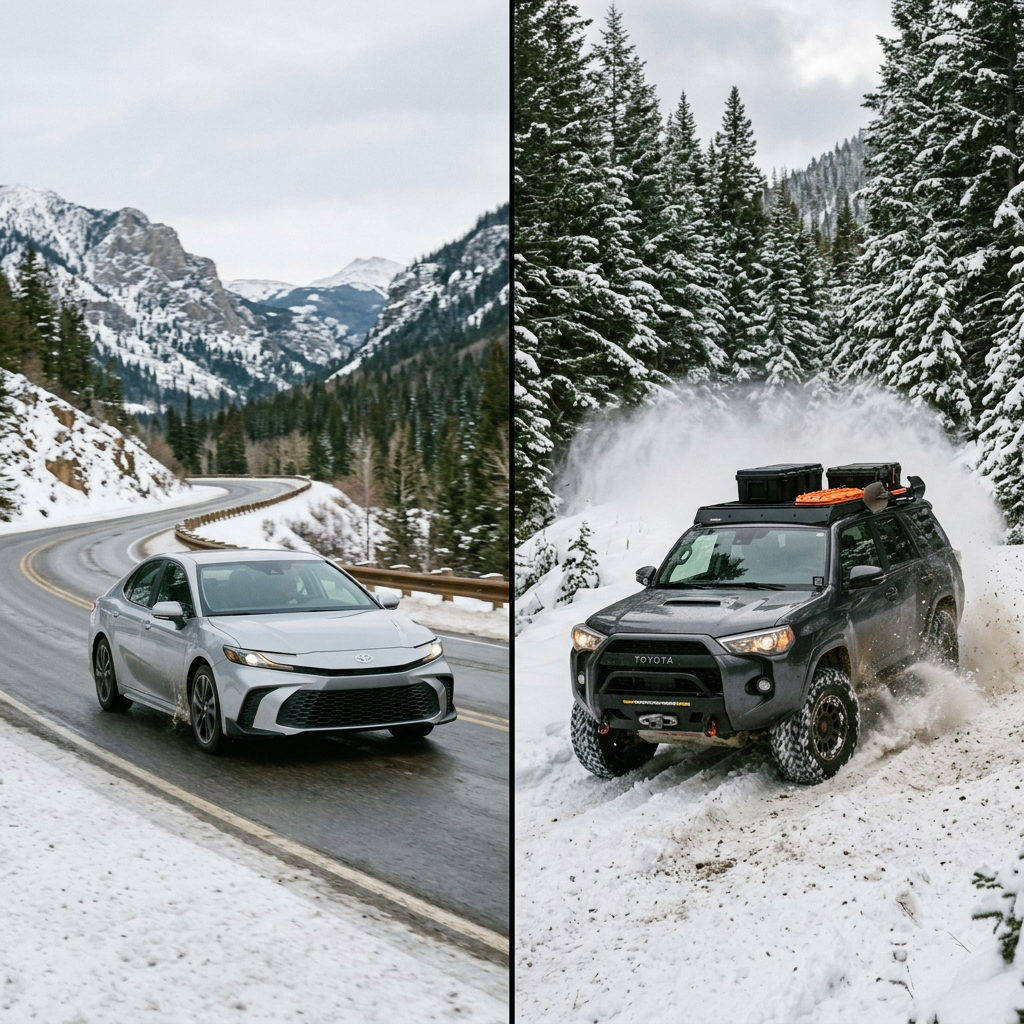
Is AWD or 4x4 better for Wyoming winter driving? When the conversation turns to highway safety and daily winter commuting, AWD is generally recommended over 4x4. Highways during a Wyoming winter are rarely uniform; you will frequently encounter a rapidly changing mix of dry asphalt, packed snow, black ice, and slush. Because an AWD system is constantly active and can shift torque between axles in milliseconds, it responds instantly to localized slick spots at highway speeds. This automatic adjustment provides continuous lateral stability and helps prevent the vehicle from sliding when transitioning between clear lanes and icy patches.
A traditional 4x4 system is less suited for high-speed winter commuting on partially cleared highways. Because a part-time 4x4 system locks the axles together, keeping it engaged on a highway that alternates between dry pavement and icy patches can cause vehicle instability and driveline strain during turns. While a 4x4 system is unmatched for getting unstuck from a deep drift or driving at low speeds through heavy, unplowed snow, it does not offer the continuous, speed-adaptive cornering stability that makes AWD so reassuring on a frozen highway.
Regardless of whether your vehicle is equipped with AWD or 4x4, it is crucial to remember that drivetrain technology only assists with acceleration and power distribution; it does not increase your tires' mechanical grip when braking. Industry testing demonstrates that dedicated winter tires can reduce stopping distances on packed snow by approximately 30% or more compared to standard all-season tires. A two-wheel-drive vehicle equipped with proper snow tires will often stop and turn more effectively on ice than an AWD or 4x4 vehicle riding on worn all-season rubber.
For families and commuters in Worland, where agricultural winter travel requires reliable traction on both paved state routes and rural farm-to-market roads, keeping your vehicle's traction systems and tires in peak condition is vital. If you want to prepare your current vehicle for the upcoming cold season, you can easily schedule service online to have our technicians inspect your tread depth, rotate your tires, or check your vehicle's fluid levels. You can also explore our used-vehicle inventory to find pre-owned trucks and SUVs equipped with robust winter-ready drivetrains.
Fuel Economy and Operational Cost Differences Between AWD and 4x4 Systems
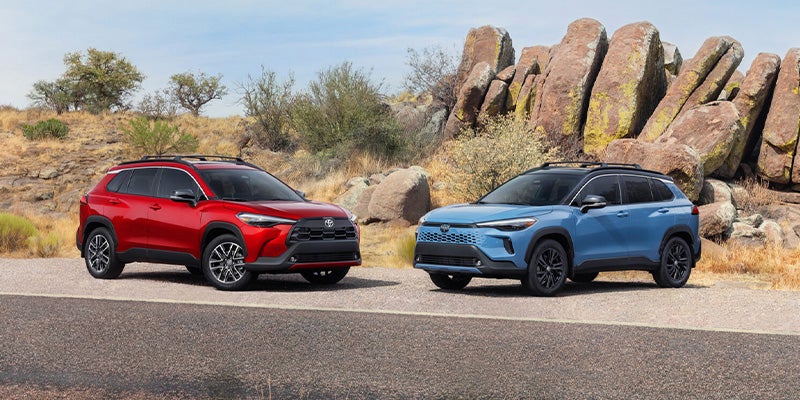
Does adding AWD reduce fuel economy less than adding 4x4 on similar vehicles? From an economic standpoint, AWD systems are generally lighter and more integrated into the vehicle's primary transaxle, which minimizes mechanical drag and weight. Many modern AWD systems are designed to operate as on-demand systems. They primarily send power to a single axle during steady highway cruising to maximize efficiency, automatically engaging the secondary axle only when onboard sensors detect wheel slippage. This smart power management allows vehicles like the 2026 Toyota RAV4 to achieve outstanding efficiency ratings, such as an EPA-estimated 47 city / 40 hwy MPG with its standard electronic AWD system.
Traditional 4x4 systems involve heavy-duty mechanical components, including a separate transfer case, front and rear differentials, and robust driveshafts. This heavy hardware adds significant curb weight to the vehicle, which naturally increases fuel consumption even when the system is operating in two-wheel-drive mode. When 4x4 is actively engaged, the mechanical friction of turning all those heavy components simultaneously further reduces fuel economy. For buyers who prioritize long-term efficiency and lower fuel costs for their daily driving, an AWD system is almost always the more cost-effective choice.
Operational costs also extend to maintenance and long-term care. Because 4x4 systems are built for severe duty, they require periodic transfer case fluid changes and differential fluid services, especially if the vehicle is regularly driven through water, mud, or heavy snow. If you ever need replacement components or specialized fluids for your vehicle's drivetrain, you can easily order parts directly through our website.
Towing Campers and Handling Mountain Passes Like South Pass
Can you tow a camper with an AWD SUV? The answer is yes, but with certain mechanical limitations. Many modern midsize and full-size AWD SUVs are fully capable of towing light utility trailers, pop-up campers, or small travel trailers. However, because AWD SUVs typically use unibody construction and independent suspension systems, they are generally rated for lower maximum towing capacities than body-on-frame 4x4 trucks. When towing with an AWD vehicle, it is essential to stay well within the manufacturer's specified towing and payload limits to avoid overheating the transmission or straining the center differential.
When it comes to tackling demanding mountain routes, which system is better for driving over South Pass near Lander? This high-elevation highway is notorious for sudden ground blizzards, high winds, and rapidly accumulating drifts. If the pass is open and the road surface is covered in a variable mix of packed snow, blown ice, and slush, an AWD system is highly effective. It continuously adjusts power to all four wheels to maintain momentum and directional stability at highway speeds.
However, if a severe winter storm catches you before the snowplows can clear the road, or if you must navigate deep, unplowed drifts and steep, unpaved access roads, a traditional 4x4 system with high ground clearance is the superior choice. Shifting into 4WD Low provides the mechanical torque multiplication and locked traction needed to plow through heavy snow accumulation without getting stuck.
For outdoor enthusiasts who regularly haul gear, boats, or campers into the backcountry, matching your vehicle's drivetrain to your towing and terrain needs is essential. If you are considering upgrading to a more capable AWD or 4x4 vehicle in Wyoming for your mountain adventures, you can value your trade-in online today to see how much equity you can put toward your next vehicle purchase.
Common Questions About AWD and 4x4 Performance in Wyoming
Q: Can I drive a 4x4 vehicle on dry pavement?
Traditional part-time 4x4 systems should never be driven on dry pavement when four-wheel drive is engaged. Because the front and rear axles are mechanically locked together in 4WD mode, they must rotate at the same speed. When you turn on a high-grip surface like dry asphalt, the wheels need to spin at different speeds, which causes severe driveline binding, tire hopping, and potential mechanical damage. Always shift back into 2WD when returning to dry roads.
Q: Does AWD turn off automatically at highway speeds?
Many modern, electronically controlled AWD systems are designed to automatically transition power away from the secondary axle at highway cruising speeds to optimize fuel efficiency. If the system's sensors detect any wheel slip, wind gusts, or sudden steering inputs, the system will instantly re-engage the AWD system to provide maximum stability.
Q: What is the benefit of 4WD Low range?
The 4WD Low setting uses a lower gear ratio inside the transfer case to multiply engine torque while reducing the vehicle's wheel speed. This setting is specifically designed for low-speed, high-torque situations, such as crawling over steep rocky terrain, pulling a heavy load up a steep incline, or extracting a vehicle from deep mud or heavy snow.
Q: How does Toyota's electronic AWD differ from mechanical AWD?
Toyota's electronic AWD system, often found on hybrid models like the RAV4 Hybrid, does not use a physical driveshaft running from the front engine to the rear wheels. Instead, it utilizes an independent electric motor mounted directly on the rear axle to power the rear wheels automatically when extra traction is needed. This design reduces mechanical weight and friction, resulting in superior fuel economy.
Q: How do I know which system is right for my daily commute?
If your daily commute consists primarily of maintained highways and city streets, AWD offers the best balance of automatic winter traction, fuel efficiency, and smooth on-road handling. If your daily route includes unpaved ranch roads, steep unplowed driveways, or heavy off-road use, a traditional 4x4 system is highly recommended.
Finding Your Perfect Winter-Ready Vehicle in Lander
Selecting the ideal drivetrain is all about matching vehicle capability to your personal lifestyle, daily driving habits, and the specific routes you travel. Whether you prefer the seamless, automated security of an all-wheel-drive crossover for highway commuting or the rugged, mechanical durability of a four-wheel-drive SUV for backcountry exploration, finding the right fit is easy when you have the right team supporting you.
At Fremont Toyota Lander, we carry a diverse selection of new and pre-owned models equipped with advanced traction systems designed to handle the most demanding road conditions. Our experienced team is here to walk you through the mechanical differences, explain the real-world benefits of each system, and help you choose the vehicle that delivers complete peace of mind.
If you are ready to take the next step toward your next vehicle, we make it simple to begin the process from the comfort of your home. You can complete our secure online credit application to get pre-approved for financing before you visit. When you are ready to experience these systems firsthand, we invite you to stop by our showroom located at 103 Fremont St, Lander, WY 82520, or you can get directions to Fremont Toyota Lander online. For any immediate questions about our current inventory or available options, please feel free to call our sales team directly at (307) 335-3106.